The Business of Innovation in Healthcare: When Innovation Becomes the Business
When Innovation Becomes the Goal, Not the Tool
Innovation has become one of the most frequently used—and celebrated—words in global health, particularly in Africa. Across the continent, innovation hubs, accelerators, challenge funds, and scale-up programmes have emerged with the shared ambition of identifying solutions that can strengthen health systems and improve outcomes.
This focus has been valuable. Africa needs innovation. But after more than a decade working at the intersection of health systems, private sector engagement, and health financing, I increasingly find myself asking whether innovation has, in some cases, become the destination rather than the starting point.
Why Too Many Health Solutions Never Leave the Pilot Stage
Too often, healthcare solutions are developed, refined, and positioned primarily to meet the requirements of donor funding and innovation calls. Success is measured in pilots launched, grants secured, and reports delivered, rather than in customers reached, revenues generated, or services sustained at scale. This dynamic is particularly evident in long-standing donor priority areas—such as RMNCH, family planning, digital health, and mental health—where innovation pipelines are crowded, yet pathways to commercial sustainability remain limited. Over time, innovation itself risks becoming a business model—one sustained by subsidies rather than by functioning market dynamics.
This pattern is not driven by ill intent. Innovation funding plays a critical role, especially in early-stage development, high-risk environments, and underserved populations. However, when grant funding becomes a long-term substitute for commercial viability, incentives begin to shift. The urgency to test pricing, integrate into procurement systems, build a paying customer base, and develop robust revenue models weakens.
When Innovation Turns Into a Business Model: Hidden Cost of Perpetual Grant Funding
It is worth asking—carefully and constructively—whether some innovation ecosystems unintentionally over-fund promising solutions to the point where transitioning into a sustainable business becomes less attractive than remaining within the innovation pipeline.
A related issue is who tends to access innovation funding. Innovators who are well connected to global health networks, fluent in donor language, and closely aligned with international priorities often fare better than those deeply embedded in local health systems but less visible internationally or online. As a result, solutions that are technically sound and locally relevant may struggle to attract funding, while others that are more legible to donors advance—regardless of their long-term viability.
A Gap Is Not a Market: Need Alone Is Not a Business Model
A recurring misconception underpinning many of these dynamics is the assumption that a gap in the health system automatically represents a viable market. In reality, a gap is often easy to spot; a market is much harder to prove.
Many healthcare innovations fail not because the need is not real, but because the economic, behavioural, and institutional conditions required for sustained adoption do not exist. In Africa, gaps are frequently created by affordability constraints, weak or fragmented procurement mechanisms, misaligned and multiple payers, regulatory inertia, or limited delivery infrastructure. Filling such a gap with a technically elegant solution does not automatically create willingness to pay, reimbursement pathways, or scalable demand. Need alone is not a business model.
Why Good Solutions Still Fail
The solutions that do scale in African healthcare are those that align—often imperfectly—with who pays, who decides, and who delivers. They respect constrained unit economics, fit within existing clinical and administrative workflows, and address problems that already have a budget line, however small or inefficient that budget may be. Innovation that ignores these realities risks becoming a beautifully designed pilot that never leaves PowerPoint.
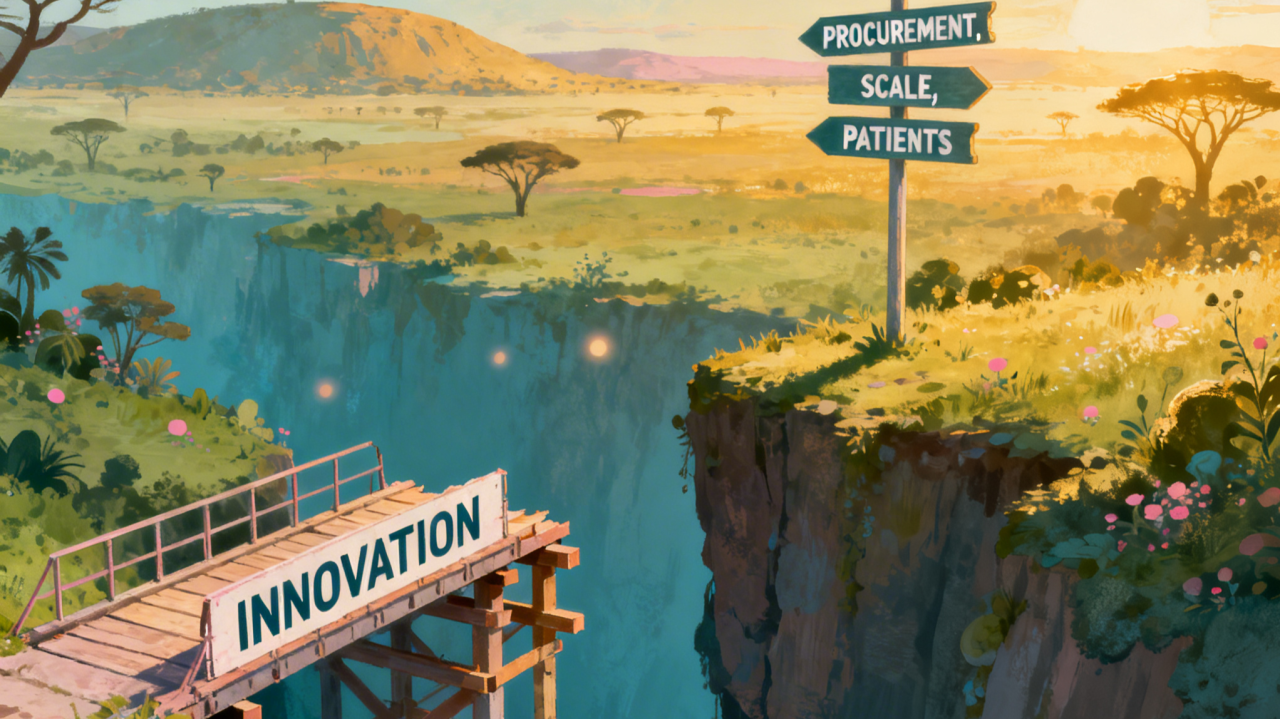
This helps explain why so many innovation programmes remain heavily front-loaded, focusing on ideation, proof of concept, and early pilots, while far less attention is paid to what comes next. The transition from pilot to procurement, from demonstration to reimbursement, and from donor support to commercial sustainability remains poorly supported—despite being the most critical phase for impact.
Market Creation Is the Real Work
This is where deliberate market creation and shaping become essential. The real opportunity in African healthcare is not only to identify gaps, but to convert them into functioning markets—by engineering trust, aligning incentives, clarifying institutional roles, and creating viable pathways to scale. This work is less visible than innovation challenges or demo days, but far more consequential. It determines whether a solution becomes embedded in health systems or remains perpetually dependent on external funding.
Approaches that deliberately combine public procurement, private insurance, employer financing, and out-of-pocket payments—rather than treating these as competing channels—are critical to this transition. Similarly, market shaping efforts that focus on predictable demand, transparent pricing, pooled procurement, regulatory clarity, and long-term financing signals are essential if innovators are to move beyond pilots.
Trapped in the “Social Enterprise” Box: Viable Businesses Forced to Stay Small
Without these conditions, innovators are often pushed—implicitly or explicitly—toward the social enterprise or non-profit space, remaining dependent on grants even where commercial pathways could exist. Over time, this reinforces a cycle in which innovation is rewarded, but business maturity is deferred.
These dynamics matter because healthcare solutions in Africa are still too often framed as innovations rather than as serious businesses. Yet African health systems are real markets. Governments procure. Insurers reimburse. Employers invest. Households pay. The challenge is not the absence of markets, but the difficulty of navigating them and aligning incentives across fragmented systems.
Innovation should remain the beginning of the journey, not its endpoint. Sustainability, integration into health systems, and measurable outcomes must define success.
If Africa is serious about building resilient health systems, we must move beyond celebrating pilots and start investing more deliberately in market shaping, business maturity, and pathways to scale. Only then can innovation translate into lasting impact—and only then can the business of health in Africa truly emerge.
About The Author
Marloes Kibacha is the co-founder and Managing Director of Africa Health Business (AHB), a pan-African healthcare advisory and consulting firm focused on health systems strengthening, market access, and private-sector engagement. With over a decade of experience working across governments, donors, investors, and health industry players, her work centres on translating policy priorities and innovations into viable, system-embedded business models. She has led and advised initiatives across multiple African countries on health financing, diagnostics, women’s health, digital health, and public–private collaboration, with a strong emphasis on sustainability, scale, and health as an investment rather than a standalone intervention.